Dissolve / Reuse / Recycle – Cradle to cradle
Notes from an interview with Prof Dr. Michael Braungart in nomad magazine.
We don’t need to build products to last forever, but build them to be fit for purpose. This means making them last as long as appropriate and then finding a way to repurpose and recycle the materials used into a something new of equally high quality.
According to Michael Braungart current efforts to reuse and recyle materials are just not good enough. For example, expensive and high-quality metals used to make cars are recycled into low grade contruction steel rather than being repurposed as high-quality metal again for new cars.
At the moment, the circular economy is optimising all the wrong things. PET bottles are being used to make surfacing for cycle paths, but the result will end up creating a microplastics problem.
While many sustainability experts focus on durability, this can come at the the cost of other factors. Car tyres as an example have greatly improved their longevity over the last thirty years, yet while they last longer they also release smaller particles massively impact air quality and can even account for half of microplastics in our rivers.
Instead of carrying on as we as we always have done, we need to take a step back and ask: What do we really want to achieve? What’s important for our quality of life?
The next generations of car and material designers should not ask themselves how to make tyres 10 or 20% better, but what role mobility is trying to achieve overall and what alternatives there are to it.
Business Model at the Heart of Sustainability
Much of current sustainabilty messaging revolves around reducing consumption. Yet with an ever increasing population this is no small ask for humaity as a whole. Instead of reducing our consumption of “bad” products, businesses should strive to build on a model in which the consumption of the product or service does not create waste, and might actually accelerate a positive effect.
What we need is a system that is quality-based, not ethics-based. A product that ends up as waste is just stupid. […] We won’t ever succeed in being good; all we can hope for is to be less bad. But there are too many of us on the planet for less bad to be enough. […] We have to learn to be useful. This means the very first thing we have to do is to look at people as the opportunity, not the problem. Instead of minimising our eco-footprint, we have to work out how to leave a great big footprint that turns into fertile wetland.
Cradle to Cradle Design
Many of the current efforts to curb our unsustainable behaviour can summarised by 3Rs: Reduce, Reuse, Recycle. While this is a good start it does nothing to address the systemic issues we face: there are limited resources and discarded items turn into toxic waste. Even at a lower consumption rate and with partial recycling we will still meet our inevitable demise when resources run out and the planet is full of toxic waste.
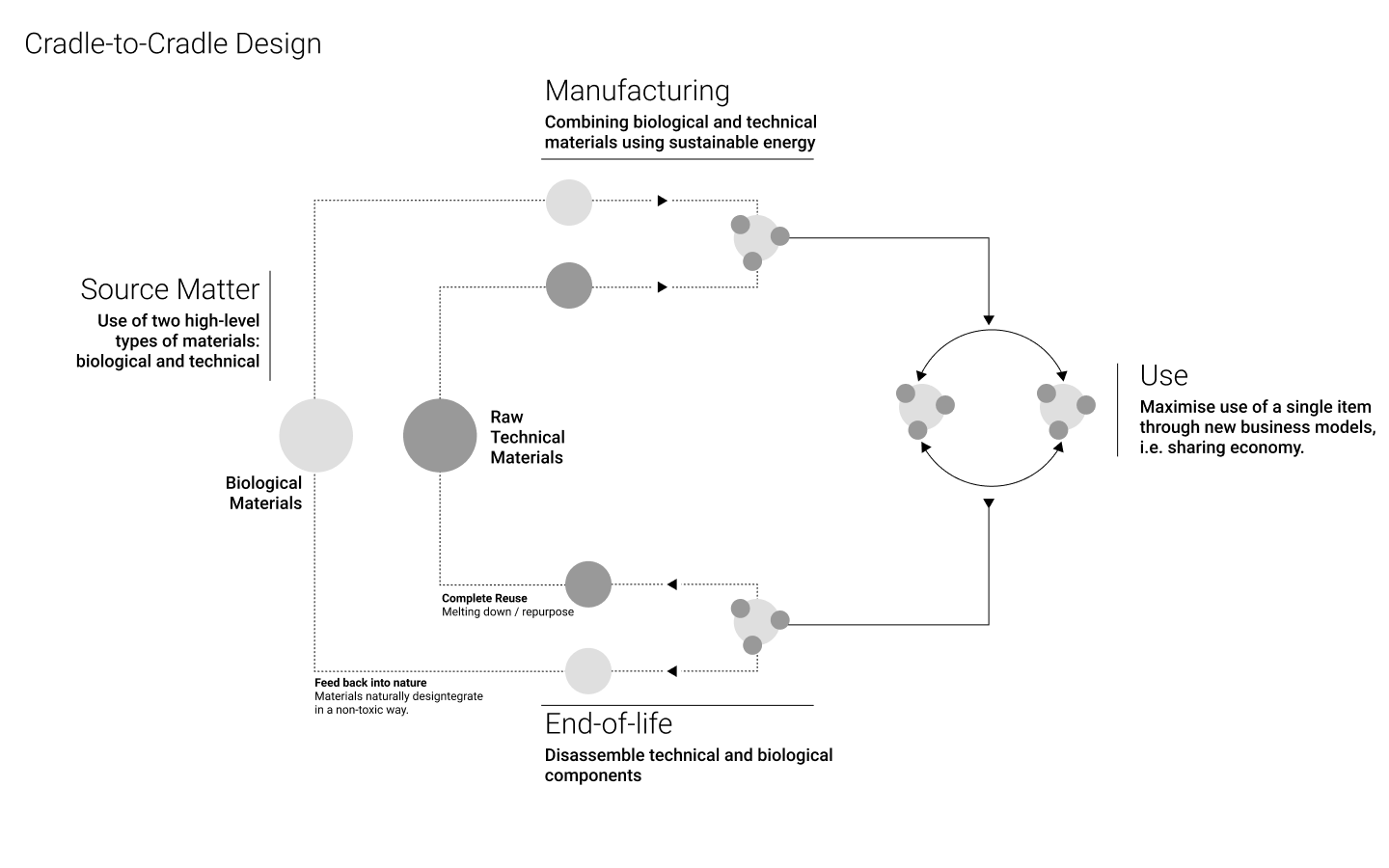
The solution is the Cradle-to-Cradle design system in which only unharmful, fully-recycleable materials are used and manufacturing energy is provided by renewable energy sources.
In Cradle-To-Cradle Design there are two key material components to any product. The biological component which is made from organic materials that can harmlessly go back into the environment and degrade. The technical components that don’t degrade as easily but can be fully broken down and repurposed when making new products.
Provocations
- Why do we need to create so much waste?
- Which products that we currently use create the most waste?
- What are our current technical constraints from achieving a cradle-to-cradle system for consumer electronics?
- How do business models need to shift before we can fully embrace cradle-to-cradle?
- What human mindsets currently prevent us from accepting cradle-to-cradle (such as the notion of ownership)? How are these different across cultures?
- What can we as individuals do to accelerate the journey to a truly sustainable product lifecycle?
Ultimately there are a huge number of hurdles to achieving this but I’d like to belive that there is a way that we can make it happen somehow.