Team Work Fludity Matrix
Teams come in many different shapes and sizes, and so do jobs. When trying to understand how different people work together and with which frequency I started working on a matrix to help categories different types of work.
Here is a very vaguely defined list which shows the types of work methods someone might engage in.
- Full-Time employees
- … in a static organisation.
- … in a fluid organisation.
- Consultants
- Contractors
- Freelancers
- Craftsmen
- Sole Trader / Self Employed
- Entrepreneurs
When trying to classify each of these roles in the fluidity matrix I make the following two observations: Team size and permanence.
Team size is split into two categories: Solo and In a Team. While most work requires some form of agreement between individuals, a solo worker does most of the work and decision making on their own, or simply follows instructions from above without question. “In a Team” requires people to work together and discuss various options and solutions before completing the task at hand, whether they belong to the same organisation or not.
When someone is a solo worker team structure does not often change. Variation may come from the number of projects or clients serviced, but at the end of the day the work is done alone.
People who work in a team can have varying degrees of team permanence. Most full-time employees will have fairly high permanence. The team structure stays mostly the same during their stay at the company. More progressive companies may have adopted responsive or fluid practices and reassemble teams on a regular basis to meet project demands. This strongly depends on company size, age and industry. Companies with a mostly static employee culture can create some fluidity by creating cross-departmental groups or committees based around certain outcomes. This will help the spread of information throughout the organisation and achieve creative cross-pollination.
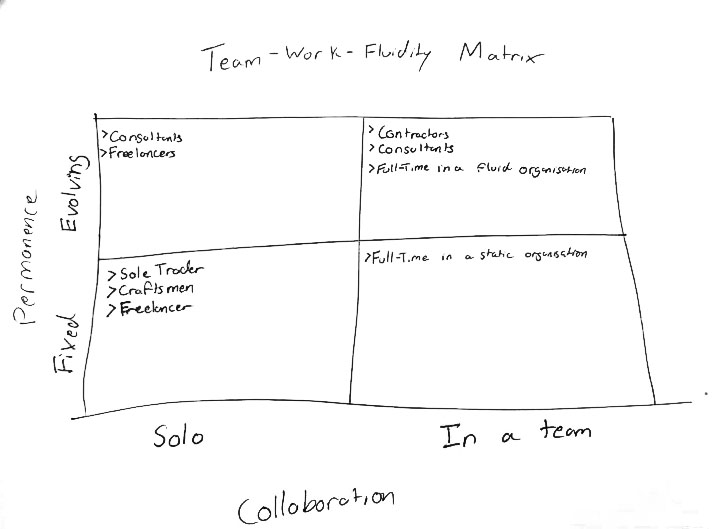
The matrix below attempts to map out some of the types of workers above and places them into one of the four categories. Some of the classifications are quite broad and can be placed in multiple quadrants.
The Quadrants
Solo + Fixed
The solo and fixed quadrant is for people who work primarily by themselves and enjoy a fair amount of regularity in their work. It’s can be a bit monotonous but can also foster extreme specialisation in a certain discipline that is done alone. Much of todays gig economy can be described as Solo + Fixed. Whether it’s a business researcher on UpWork or your Uber driver, these people usually work in silos and collaboration is rare.
Many types of freelancers also fall into this category. Independent journalists and writers…
Solo + Evolving
The solo + evolving working is a bit of an oxymoron. This is reserved for a special kind of freelancer who does most of their work alone, but still gets together with others in a team on an occasional basis. Certain types of consultants might work with a team in-house before or after their individual work and some contractors who have very specialised skills might only be needed for a short period of time.
In A Team + Fixed
Most traditional companies work in this way. Employees work full-time in a set role. The roles are fixed and everyone has one area they are responsible for. This is typical in corporate environments or in small to medium size companies.
In A Team + Evolving
People in this category work in an organisation that has a very fluid structure. Teams get together on an ad-hoc basis and the org chart is mostly flat or even holacratic. Startups are well suited for this model as one employee may be responsible for many different aspects of the business.
Contractors are part of this group as they usually work in a team, but for a limited time. They are hired for a project then join a new team or company when the project is completed.
Certain types of open source-projects can also fall into this category where contributors invest a lot of time on the same project and get to know each other through commit messages and issue discussions. Nevertheless the team is evolving, certain people loose interest and newcomers join in.